What is the mutual comprehensibility and vocabulary overlap between pairs within the list of languages such as English, Spanish and French?
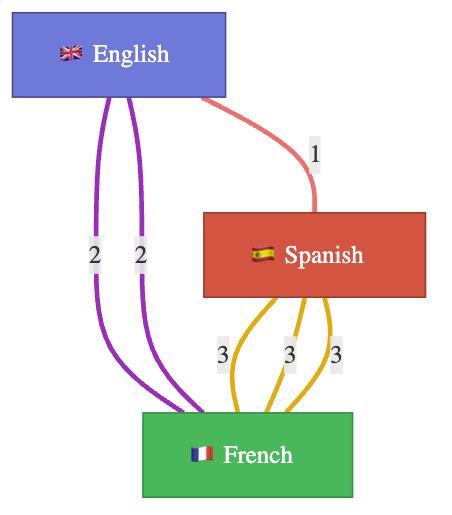
The mutual comprehensibility and vocabulary overlap between English, Spanish, and French present a fascinating linguistic landscape. While all three languages share deep historical roots, the nature and degree of their connections vary significantly. In short, Spanish and French are moderately similar, while English has an extensive vocabulary overlap with both but is not mutually intelligible with them in speech.
Here is a breakdown of the relationships between each pair.
🤝 Spanish and French: Moderately Similar, Not Mutually Intelligible
As fellow Romance languages descended from Latin, Spanish and French share a significant amount of vocabulary and grammatical structures .
- Lexical Similarity: Linguistic analyses quantify this overlap. According to research using lexical similarity coefficients, Spanish and French are estimated to be about 75% similar in their vocabulary . This is a moderate level of similarity, though it’s less than the 89% similarity shared between Spanish and Portuguese, or French and Italian .
- Mutual Intelligibility: Despite this lexical overlap, spoken mutual intelligibility is low. A native Spanish speaker cannot effortlessly understand spoken French, and vice versa. A significant study on Romance languages measured spoken intelligibility and found, for example, that Spanish speakers could only identify about 28% of words in a French cloze test, while French speakers scored around 31.5% on a similar Spanish test . This indicates that while you might pick out a familiar word here and there, following a conversation is not possible without prior study.
- Key Differences: The main barriers are pronunciation and grammar. French pronunciation is notoriously less phonetic than Spanish, with many silent letters and complex vowel sounds, while Spanish spelling is very regular . Grammatically, French has been influenced by Germanic languages, while Spanish retains a stronger Arabic influence from the Moorish occupation of the Iberian Peninsula .
🇬🇧 English and Spanish: A Cognate-Rich Connection
The link between English and Spanish is primarily lexical, stemming from Latin’s massive influence on English.
- Vocabulary Overlap: English is Germanic in structure, but its vocabulary has been profoundly shaped by Latin and French. This results in a vast number of English-Spanish cognates—words that look similar and share a common meaning. It’s estimated there are over 20,000 English-Spanish cognates . This is why a Spanish speaker can often understand the gist of a written English text, especially one with formal or academic vocabulary.
- Examples: Words like animal, considerable, and edition are either identical or very close in both languages .
- False Friends: Learners must beware of «false friends»—words that look similar but have different meanings. For instance, Spanish embarazada looks like «embarrassed» but actually means «pregnant» .
- Mutual Intelligibility: This cognate relationship does not translate to spoken mutual intelligibility. The core grammar and everyday vocabulary of English (like eat, drink, go, house) are Germanic and completely different from Spanish (comer, beber, ir, casa). An English speaker cannot understand spoken Spanish simply by virtue of knowing English.
🇬🇧 English and French: A Story of Conquest and Borrowing
The relationship between English and French is uniquely intimate due to the Norman Conquest of England in 1066 .
- Vocabulary Overlap: For centuries after the conquest, French was the language of the English court, government, and law. This led to an enormous influx of French words into English. It’s estimated that in a test like the French TEF, over 4,000 out of 7,000 common words have English equivalents that are identical or very similar . This is why English speakers can often decipher written French, particularly in formal contexts.
- Examples: Countless English verbs like to arrive (arriver), to serve (servir), and to prove (prouver) are borrowed directly from French .
- False Friends: Just as with Spanish, there are tricky false cognates, such as French travailler (to work), which looks like English «travel» .
- Mutual Intelligibility: Similar to the English-Spanish dynamic, this deep lexical connection does not make the languages mutually intelligible when spoken. The pronunciation systems are vastly different, and the core grammatical structures, while both simpler than in the past, have evolved along separate paths .
📊 At a Glance: Summary of Language Relationships
To visualize these complex relationships, the table below summarizes the key points for each language pair.
| Language Pair | Lexical Similarity | Spoken Mutual Intelligibility | Key Reason for Relationship |
|---|---|---|---|
| Spanish & French | Moderate (~75%) | Low (e.g., ~28-32% on tests) | Shared Latin origin, but different evolutions . |
| English & Spanish | High (via cognates) | None | English’s Latinate vocabulary creates many cognates . |
| English & French | Very High (via borrowed words) | None | Historical French rule of England led to massive borrowing . |
The story of English, Spanish, and French is one of shared ancestry and intense historical contact, which has resulted in a rich tapestry of linguistic connections. While this shared heritage is a tremendous asset for language learners, helping to build vocabulary faster, the distinct evolution of each language’s grammar and pronunciation ensures that they remain separate, non-mutually intelligible tongues.
