📌 Subject Pronouns
Subject pronouns replace the name of the person or thing doing the action.
Spanish has more subject pronouns than English because it distinguishes between formal/informal and masculine/feminine groups.
👤 Singular Subject Pronouns
| Pronoun | Meaning | When to use |
|---|---|---|
| yo | I | Always used (but often omitted with verbs) |
| tú | you (familiar, singular) | Friends, family, children, pets |
| él | he | Any male person |
| ella | she | Any female person |
| usted (Ud.) | you (formal, singular) | Strangers, bosses, elderly, business situations |
👥 Plural Subject Pronouns
| Pronoun | Meaning | When to use |
|---|---|---|
| nosotros | we | Group that includes at least one male (or all males) |
| nosotras | we (all female) | Group of only females |
| vosotros | you (familiar, plural) | Only in Spain – informal group |
| vosotras | you (familiar, plural, all female) | Only in Spain, all-female group |
| ellos | they (masculine or mixed) | Group of males or males+females |
| ellas | they (feminine) | Group of only females |
| ustedes (Uds.) | you (plural, formal/informal) | Used in all of Latin America for any plural “you”; in Spain, it is formal plural |
📘 Important: Spanish has no subject pronoun for “it”. Use él or ella only for people or sometimes animals – never for things.
🧭 The Two Verbs “To Be” in Spanish
Spanish has two verbs that mean to be:
- Estar → temporary states, location, health, conditions
- Ser → permanent characteristics, origin, identity
This chapter focuses on Estar.
📖 Estar – Conjugation (Present Tense)
Estar is an irregular verb. Memorize its forms.
| Subject | Conjugation | Meaning |
|---|---|---|
| yo | estoy | I am |
| tú | estás | you are (familiar) |
| él / ella / Ud. | está | he / she / you (formal) is/are |
| nosotros / nosotras | estamos | we are |
| vosotros / vosotras | estáis | you are (Spain, plural familiar) |
| ellos / ellas / Uds. | están | they / you (plural) are |
✅ Pattern to notice: The same verb form is used for él, ella, and Ud. (third-person singular).
The same form is used for ellos, ellas, and Uds. (third-person plural).
🗺️ Four Main Uses of Estar
1️⃣ Location (Where something/someone is)
Rule: Use estar to say where a person, animal, or thing is physically located.
| Spanish | English |
|---|---|
| Yo estoy en la biblioteca. | I am in the library. |
| El perro está en el jardín. | The dog is in the garden. |
| ¿Dónde están las llaves? | Where are the keys? |
| Nosotros estamos cerca del museo. | We are near the museum. |
2️⃣ Health (Physical or emotional state)
Rule: Use estar to describe how someone feels or their physical condition.
| Spanish | English |
|---|---|
| Ella está cansada. | She is tired. |
| Los niños están enfermos. | The children are sick. |
| ¿Cómo estás? – Estoy regular. | How are you? – I’m so-so. |
| Mi abuela está mejor hoy. | My grandmother is better today. |
3️⃣ Changing Mood or Condition (Temporary states)
Rule: Use estar for emotions, moods, and conditions that are not permanent.
| Spanish | English |
|---|---|
| Estoy feliz. | I am happy. |
| Ellos están nerviosos por el examen. | They are nervous about the exam. |
| La sopa está fría. | The soup is cold. (It became cold) |
| ¿Estás enojado conmigo? | Are you angry with me? |
4️⃣ Personal Opinion – Taste or Appearance
Rule: When estar is used with food, it often means “tastes” (not just “is”).
When used with appearance, it means “looks”.
| Spanish | English |
|---|---|
| El pastel está delicioso. | The cake tastes delicious. |
| La limonada está muy ácida. | The lemonade tastes very sour. |
| Tú estás guapo hoy. | You look handsome today. |
| Ella está elegante con ese vestido. | She looks elegant in that dress. |
💡 Important Notes & Tips
🔹 Omitting Subject Pronouns
Because the verb form already tells you who the subject is, pronouns like yo, tú, and nosotros are often omitted unless you want to emphasize or clarify.
- Estoy en casa. (I am at home) – No yo needed.
- ¿Estás listo? (Are you ready?) – No tú needed.
🔹 Word Order
For the basic sentences in this chapter, English and Spanish word order is the same: Subject + Verb + Rest of sentence.
- Ella está en el coche. = She is in the car.
- Nosotros estamos contentos. = We are happy.
🔹 Adjective Agreement Reminder
Adjectives that follow estar must agree in gender and number with the subject.
- El hombre está cansado. (masculine singular)
- La mujer está cansada. (feminine singular)
- Ellos están cansados. (masculine plural)
- Ellas están cansadas. (feminine plural)
🧪 Quick Practice (Try these)
Translate to Spanish using estar:
- I am in the classroom.
- The book is on the table.
- We are tired.
- Are you (formal, singular) angry?
- The tacos taste good.
(Answers: 1. Yo estoy en la clase. 2. El libro está en la mesa. 3. Nosotros estamos cansados. 4. ¿Está Ud. enojado? 5. Los tacos están buenos.)
📚 Summary Table – Estar at a Glance
| Use | Example | Translation |
|---|---|---|
| 📍 Location | El banco está en la calle principal. | The bank is on Main Street. |
| 🩺 Health | Estoy mareado. | I am dizzy. |
| 😊 Mood/Condition | Ella está aburrida. | She is bored. |
| 👗 Appearance | Ellos están guapos. | They look handsome. |
| 🍽️ Taste | La pizza está quemada. | The pizza tastes burnt. |
Next chapter: The verb Ser – for permanent traits, origin, and identity.
Ser – The Other Spanish “To Be”
🧠 Why Two Verbs?
In English, to be works for everything:
- The dog is here. (location)
- The dog is brown. (description)
Spanish makes a distinction:
- Estar → temporary states (location, health, mood)
- Ser → permanent or essential qualities (description, origin, identity, etc.)
This chapter focuses on Ser.
📖 Ser – Conjugation (Present Tense)
Ser is highly irregular. Memorize these forms.
| Subject | Conjugation | Meaning |
|---|---|---|
| yo | soy | I am |
| tú | eres | you are (familiar) |
| él / ella / Ud. | es | he / she / you (formal) is/are |
| nosotros / nosotras | somos | we are |
| vosotros / vosotras | sois | you are (Spain, plural familiar) |
| ellos / ellas / Uds. | son | they / you (plural) are |
✅ Pattern: él, ella, Ud. share the same form (es).
ellos, ellas, Uds. share son.
🗺️ Seven Uses of Ser
1️⃣ Description (Permanent characteristics)
Rule: Use ser for colors, size, personality, and other inherent traits.
| Spanish | English |
|---|---|
| La casa es roja. | The house is red. |
| El cielo es azul. | The sky is blue. |
| Los perros son grandes. | The dogs are big. |
| Nosotros somos amables. | We are kind. |
2️⃣ Profession
Rule: Use ser to state someone’s job or occupation.
📘 Important: Do not use un/una (a/an) before an unmodified profession.
| ✅ Correct | ❌ Incorrect |
|---|---|
| Ella es doctora. | Ella es una doctora. |
| Él es estudiante. | Él es un estudiante. |
| Somos ingenieros. | Somos unos ingenieros. |
Exception: Add un/una if the profession is modified by an adjective or clause.
- Él es un estudiante excelente. (He is an excellent student.)
New examples:
| Spanish | English |
|---|---|
| Yo soy profesor. | I am a teacher. |
| Ellas son abogadas. | They (f) are lawyers. |
| Mi padre es arquitecto. | My father is an architect. |
3️⃣ Point of Origin (Where someone/something is from)
Rule: Use ser + de to express origin. The preposition de means from.
📍 Word order rule: In Spanish, a preposition can never end a sentence.
- English: Where are you from?
- Spanish: ¿De dónde eres? (literally: From where are you?)
| Spanish | English |
|---|---|
| Yo soy de México. | I am from Mexico. |
| ¿De dónde es ella? | Where is she from? |
| El vino es de Francia. | The wine is from France. |
| Somos de Japón. | We are from Japan. |
4️⃣ Identification
Rule: Use ser to specify relationships, nationality, race, religion, or identity.
| Spanish | English |
|---|---|
| Ellos son mis amigos. | They are my friends. |
| Ana y Luisa son hermanas. | Ana and Luisa are sisters. |
| Carlos es chileno. | Carlos is Chilean. |
| Nosotros somos budistas. | We are Buddhists. |
5️⃣ Material (What something is made of)
Rule: Use ser + de (meaning of or made of).
| Spanish | English |
|---|---|
| La mesa es de madera. | The table is made of wood. |
| La bolsa es de plástico. | The bag is made of plastic. |
| Los anillos son de oro. | The rings are made of gold. |
| La estatua es de piedra. | The statue is made of stone. |
6️⃣ Possession or Ownership
Rule: Use ser + de (meaning of or belonging to).
There is no apostrophe in Spanish. Instead of Peter’s car, say the car of Peter.
| Spanish | Literal | Natural English |
|---|---|---|
| El libro es de Juan. | The book is of Juan. | The book is Juan’s. |
| La casa es de mi madre. | The house is of my mother. | The house belongs to my mother. |
| Los perros son del niño. | The dogs are of the boy. | The dogs are the boy’s. |
🔗 Contraction alert: de + el = del (of the)
- Los zapatos son del hombre. (The shoes are the man’s.)
This is one of only two contractions in Spanish (the other is a + el = al).
7️⃣ Where an Event Takes Place
Rule: Use ser (not estar) for the location of events (parties, concerts, meetings).
The English translation often becomes takes place.
| Spanish | English |
|---|---|
| La fiesta es en mi casa. | The party takes place at my house. |
| El concierto es en el parque. | The concert takes place in the park. |
| La reunión es en la oficina. | The meeting takes place in the office. |
⚠️ Contrast with estar:
- El museo está en Madrid. (The museum is located in Madrid – physical location of a thing)
- La exposición es en el museo. (The exhibition takes place at the museum – event)
📊 Summary Table – Ser at a Glance
| Use | Key phrase / structure | Example |
|---|---|---|
| 🎨 Description | ser + adjective | El coche es rápido. |
| 👔 Profession | ser + noun (no article) | Ella es enfermera. |
| 🌍 Origin | ser + de + place | Somos de Canadá. |
| 🆔 Identification | ser + nationality/relation | Él es mi primo. |
| 🪨 Material | ser + de + material | La silla es de plástico. |
| 🔑 Possession | ser + de + owner | El gato es de Lucía. |
| 📅 Event location | ser + en + place | La boda es en la iglesia. |
💡 Final Tips
- No apostrophe in Spanish – use de for possession.
- Only two contractions: del (de + el) and al (a + el).
- Professions omit un/una unless modified.
- Prepositions never end a sentence – put de before dónde in origin questions.
- Events use ser, even for location (because it’s the nature of the event, not a temporary physical place).
Next: Compare Ser vs. Estar side by side.
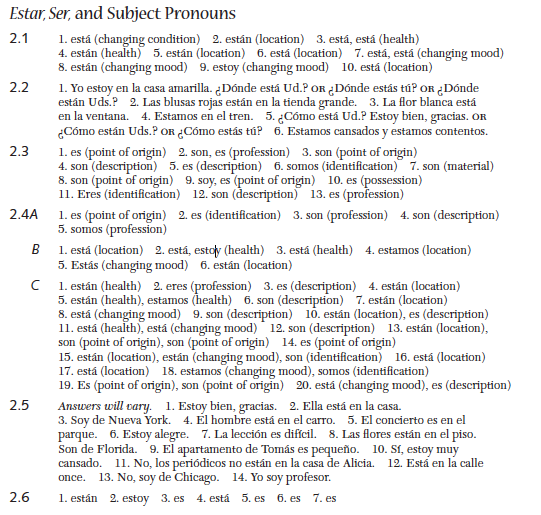
EXERCISES
(2.1) ESTAR – Health, Location, Mood, Condition
(2.2) Translation: English → Spanish
(2.3) SER – Descripción, Profesión, Origen, Identificación, Material, Posesión
ANSWERS