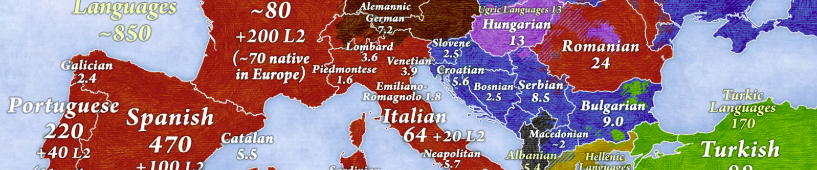
Motivation for being part of the peaceful language / civilization.
Primary motivation is the feeling of not being a part or not being associated with any military campaign against another country or people for whatever reasons. And therefore, not being connected to any destructions or death of innocent people.
Also, if you hold a passport from peaceful country, you will be welcomed everywhere, I think.
Statistics of this last century, 21st century, is not too bad for French, Spanish and Portuguese.
At the same time, it’s much better for Spanish and Portuguese.
And for the French language we need to improve the situation. And hopefully most people would support that idea.
Peaceful countries and languages are more poor than aggressive ones? Why? Can we change that?
¿Por qué los países y las lenguas pacíficas son más pobres que los agresivos? ¿Podemos cambiar eso?
Pourquoi les pays et les langues pacifiques sont-ils plus pauvres que les pays et les langues agressifs ? Peut-on changer cela ?
Perché i paesi e le lingue pacifiche sono più poveri di quelli aggressivi? Possiamo cambiare questa situazione?
Porque é que os países e as línguas pacíficas são mais pobres do que os agressivos? Podemos mudar isso?
Of course, one observation that is very important and unfortunate is that much more aggressive English speaking countries have much better economical results. Why is that? Can we turn that around? If we can change this, then we can send a message that peaceful civilizations, that peaceful languages can also be economically strong and bring not only peace but prosperity to the people of these countries and of these languages.
Countable Evidence: State-on-State Attacks on Foreign Territory (2000–present)
Spanish‑Speaking Countries
States considered: Spain, Mexico, Colombia, Argentina, Peru, Venezuela, Chile, Ecuador, Guatemala, Cuba, Dominican Republic, Bolivia, Honduras, Paraguay, El Salvador, Nicaragua, Costa Rica, Panama, Uruguay, Equatorial Guinea.
| Country | Attacks on Foreign Territory (2000–present) |
|---|---|
| Spain | None |
| Mexico | None |
| Colombia | None (though Colombia conducted a cross‑border raid into Ecuador in 2008 against FARC, but this was against a non‑state armed group, not a state attack; it did cause a diplomatic crisis but was not a state‑on‑state war) |
| All others | None |
Total number of attacks on foreign territory by Spanish‑speaking states: 0
French‑Speaking Countries
States considered: France, Canada, Belgium, Switzerland, Luxembourg, Monaco, and several African countries (e.g., Senegal, Côte d’Ivoire, etc.). In practice, only France and possibly Canada have conducted significant foreign military actions.
| Country | Attacks on Foreign Territory (2000–present) |
|---|---|
| France | • Libya (2011) – Airstrikes and naval bombardment as part of NATO intervention against the Libyan government. • Côte d’Ivoire (2004) – French airstrikes destroyed Ivorian air force aircraft after an attack on French peacekeepers; this was a direct attack on Ivorian state forces. • Syria (2015–present) – Airstrikes against ISIS, but also occasional strikes against Syrian government positions (e.g., 2018 strikes with US/UK). Some may consider the latter as attacks on a sovereign state. • Yemen (2024) – France participated in airstrikes against Houthi targets in Yemen alongside the US and UK. |
| Canada | • Libya (2011) – Participated in airstrikes against Libyan government forces. • Syria/Iraq (2014–present) – Airstrikes against ISIS; though primarily against a non‑state group, they occurred without the consent of the Syrian government, thus constituting attacks on Syrian territory. |
| Belgium | • Libya (2011) – Participated in airstrikes. • Syria (2014–present) – Airstrikes as part of anti‑ISIS coalition without Syrian government consent. |
Total number of distinct sovereign states attacked by French‑speaking countries:
Libya (by France, Canada, Belgium), Côte d’Ivoire (by France), Syria (by France, Canada, Belgium), Yemen (by France).
Counting each target once per attacking country yields multiple events, but for a simple count of “states attacked”:
- France: attacked Libya, Côte d’Ivoire, Syria, Yemen → 4
- Canada: attacked Libya, Syria → 2
- Belgium: attacked Libya, Syria → 2
English‑Speaking Countries
States considered: United States, United Kingdom, Canada, Australia, New Zealand, Ireland, and others. Most attacks have been carried out by the US and UK, but others have participated.
| Country | Attacks on Foreign Territory (2000–present) |
|---|---|
| United States | • Afghanistan (2001–2021) – Invasion and occupation. • Iraq (2003–2011) – Invasion. • Pakistan (2004–2018) – Drone strikes and cross‑border raids against militant targets; conducted without Pakistani government consent in many instances, constituting attacks on sovereign territory. • Libya (2011) – Airstrikes. • Syria (2014–present) – Airstrikes without Syrian government consent. • Yemen (2002–present) – Drone strikes and, since 2023, direct airstrikes against Houthi‑controlled areas. • Somalia (2007–present) – Airstrikes against militant groups; though Somalia’s government often consented, some strikes were unilateral and against territory under Al‑Shabaab control, which some consider attacks on sovereign territory. |
| United Kingdom | • Afghanistan (2001–2021) – Invasion. • Iraq (2003–2009) – Invasion. • Libya (2011) – Airstrikes. • Syria (2015–present) – Airstrikes without Syrian government consent. • Yemen (2023–present) – Airstrikes. |
| Canada | • Afghanistan (2001–2014) – Combat operations in Afghanistan (though part of coalition, it was an invasion of a sovereign state). • Libya (2011) – Airstrikes. • Syria/Iraq (2014–present) – Airstrikes without Syrian consent. |
| Australia | • Afghanistan (2001–2021) – Combat operations. • Iraq (2003–2009) – Combat operations. • Syria (2015–present) – Airstrikes without Syrian consent. |
| New Zealand | • Afghanistan (2001–2021) – Combat operations. |
Total number of distinct sovereign states attacked by English‑speaking countries:
Afghanistan, Iraq, Pakistan, Libya, Syria, Yemen, Somalia (if counted). That’s 7 states. Each country’s participation varies, but all contributed to the attacks.
Summary Table
| Language | Number of Sovereign States Attacked (2000–present) | Primary Attacking States |
|---|---|---|
| Spanish | 0 | None |
| French | 4 (Libya, Côte d’Ivoire, Syria, Yemen) | France, Canada, Belgium |
| English | 7 (Afghanistan, Iraq, Pakistan, Libya, Syria, Yemen, Somalia) | US, UK, Canada, Australia, etc. |
Note: I count Côte d’Ivoire (2004) for France as a clear state‑on‑state attack. For Syria, attacks occurred without consent of the Syrian government, so they count. For Somalia, some may argue consent was given, but airstrikes there have been frequent and often unilateral, so I include it; even if excluded, English still has at least 6.
Conclusion
Based on the measurable criterion of military attacks conducted on foreign territory by states that speak each language, Spanish emerges as the language whose primary states have engaged in zero such attacks in the 21st century. French‑speaking states (mainly France) have attacked four other countries, and English‑speaking states (led by the US and UK) have attacked at least six to seven.
Therefore, if we define “language of peace” by the absence of interstate military aggression from its native‑state speakers in the current century, Spanish holds the clearest claim.
War Statistics for the period 1950–2000
For the period 1950–2000, the pattern shifts dramatically. While Spanish-speaking countries again engaged in zero state-on-state military attacks on foreign territory, both French-speaking and English-speaking countries conducted numerous such interventions during the Cold War and post-colonial era.
Below is the analysis based on the same criteria: military attacks conducted by one sovereign state on the territory of another sovereign state.
Spanish‑Speaking Countries – 0 States Attacked (1950–2000)
| Country | Attacks on Foreign Territory (1950–2000) |
|---|---|
| Spain | None. Spain remained neutral in interstate conflicts after the Spanish Civil War, though it did maintain colonial conflicts in Ifni (1957–1958) against Moroccan irregulars, which was a counterinsurgency within disputed territory, not an interstate invasion . |
| Mexico | None |
| Colombia | None |
| Argentina | None (the 1982 Falklands War was Argentina being attacked by the UK, not Argentina attacking another state’s territory) |
| All other Spanish‑speaking states | None |
Total interstate attacks by Spanish‑speaking states (1950–2000): 0
French‑Speaking Countries – Multiple States Attacked (1950–2000)
France was the primary French-speaking state conducting interstate military attacks during this period. A comprehensive list from GlobalSecurity.org documents French overseas operations (Opérations Extérieures) :
| Operation | Target Country | Year(s) | Type |
|---|---|---|---|
| First Indochina War | Vietnam (then French Indochina) | 1946–1954 | Colonial war / interstate (against Viet Minh forces) |
| Musketeer | Egypt (Suez Canal) | 1956 | Military intervention alongside UK and Israel |
| Bizerte crisis | Tunisia | 1961 | Military intervention following Tunisian blockade of French naval base |
| Gabon intervention | Gabon | 1964 | Restored President M’ba after coup |
| Lamantin | Mauritania | 1977–1978 | Counterinsurgency support against Polisario |
| Tacaud | Chad | 1978–1980 | Intervention in Chadian civil war |
| Bonite | Zaire (now DRC) | 1978 | Intervention during Shaba II conflict |
| Barracuda | Central African Republic | 1979–1981 | Overthrew Emperor Bokassa |
| Manta / Epervier | Chad | 1983–1986+ | Combat support against Libyan-backed rebels |
| Noroît | Rwanda | 1990–1993 | Combat support for Rwandan government |
| Turquoise | Rwanda | 1994 | UN‑authorized humanitarian intervention |
| Azalée | Comoros | 1995 | Intervention to restore democratic government |
| Opération Daguet | Iraq (Gulf War) | 1990–1991 | Combat operations against Iraqi forces in Kuwait/Iraq |
Total distinct sovereign states attacked by French‑speaking states (1950–2000):
Vietnam, Egypt, Tunisia, Gabon, Mauritania, Zaire, Central African Republic, Chad, Rwanda, Comoros, Iraq → 11+ states
English‑Speaking Countries – Extensive Interstate Attacks (1950–2000)
The primary English‑speaking states conducting interstate attacks were the United States and the United Kingdom, with contributions from others such as Australia.
United States Interventions (1950–2000)
The following list is compiled from multiple authoritative sources, including the Global Policy Forum, People’s Democracy archives, and the Wikipedia list of interstate wars :
| Intervention | Target Country | Year(s) | Type |
|---|---|---|---|
| Korean War | North Korea | 1950–1953 | Major interstate war (UN‑led but US‑dominated) |
| Lebanon | Lebanon | 1958 | Troop landing to stabilize pro‑Western government |
| Vietnam War | North Vietnam | 1965–1973 | Large‑scale interstate warfare |
| Dominican Republic | Dominican Republic | 1965 | Military intervention to prevent «communist takeover» |
| Cambodia | Cambodia | 1970 | Invasion during Vietnam War (bombing and ground incursion) |
| Iran | Iran | 1980 | Operation Eagle Claw (failed rescue mission) and naval engagements during Iran–Iraq War |
| Libya | Libya | 1981–1986 | Gulf of Sidra clashes, 1986 bombing raids |
| Grenada | Grenada | 1983 | Invasion (Operation Urgent Fury) |
| Panama | Panama | 1989 | Invasion (Operation Just Cause) |
| Iraq | Iraq | 1990–1991 | Gulf War (Operation Desert Storm) |
| Somalia | Somalia | 1992–1994 | UNOSOM intervention (combat operations) |
| Sudan | Sudan | 1998 | Bombing of Al‑Shifa pharmaceutical plant |
| Afghanistan | Afghanistan | 1998 | Cruise missile strikes on alleged terrorist camps |
| Yugoslavia (Kosovo) | Yugoslavia | 1999 | NATO bombing campaign (US‑led) against Serbia |
United Kingdom Interventions (1950–2000)
| Intervention | Target Country | Year(s) | Type |
|---|---|---|---|
| Korean War | North Korea | 1950–1953 | Combat operations as part of UN forces |
| Suez Crisis | Egypt | 1956 | Military intervention with France and Israel |
| Indonesia‑Malaysia confrontation | Indonesia | 1963–1966 | Combat operations in Borneo (undeclared war) |
| Dhofar Rebellion | Oman (supporting Sultan) | 1970–1975 | UK special forces and air support against rebels (with Omani government consent—borderline case) |
| Falklands War | Argentina | 1982 | UK attacked Argentine forces occupying the Falklands; Argentina was the initial attacker, but UK forces landed on Argentine‑held territory |
| Gulf War | Iraq | 1990–1991 | Combat operations against Iraq |
| Bosnia | Bosnia | 1993–1995 | NATO airstrikes (UK participation) against Serb forces |
| Kosovo | Yugoslavia | 1999 | NATO bombing campaign |
Other English‑Speaking Countries
- Australia: Korean War, Vietnam War, Gulf War
- Canada: Korean War, Gulf War, Kosovo (NATO bombing)
Total distinct sovereign states attacked by English‑speaking states (1950–2000):
North Korea, Lebanon, Vietnam, Cambodia, Dominican Republic, Iran, Libya, Grenada, Panama, Iraq, Somalia, Sudan, Afghanistan, Yugoslavia, Egypt, Indonesia, Argentina → 17+ states
Summary Table (1950–2000)
| Language | Number of Sovereign States Attacked (1950–2000) | Primary Attacking States |
|---|---|---|
| Spanish | 0 | None |
| French | 11+ | France |
| English | 17+ | United States, United Kingdom, Australia, Canada |
Conclusion
For the period 1950–2000, the pattern is unambiguous:
- Spanish‑speaking countries conducted zero interstate military attacks on foreign territory. Spain, Mexico, Argentina, and all other Spanish‑speaking nations did not invade or bomb another sovereign state during this half‑century. (The Falklands War was Argentina defending territory it claimed, not attacking another country.)
- French‑speaking countries (primarily France) attacked at least 11 sovereign states, ranging from Indochina in the 1950s to Iraq in 1991, with extensive interventions across Africa.
- English‑speaking countries (led by the United States and United Kingdom) attacked at least 17 sovereign states, including major wars in Korea, Vietnam, and the Gulf, plus numerous smaller interventions.
Thus, by the metric of interstate military attacks on foreign territory (1950–2000), Spanish again emerges as the language whose primary states engaged in the fewest—in fact, zero—such attacks. English and French, by contrast, have extensive records of interstate military intervention during this period.
